Loading...
featured
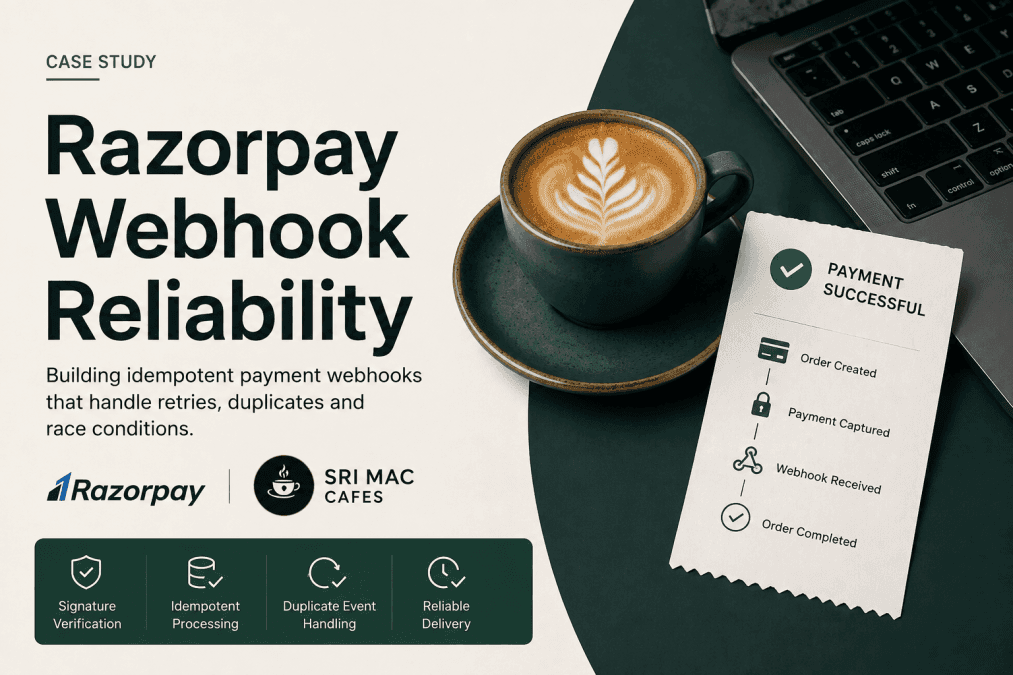
Razorpay Webhook Reliability at Srimaccafes
RazorpayPaymentsWebhooksNode.jsBackendReliabilityIdempotencyAPI IntegrationSrimaccafes
Building idempotent payment webhook handlers that survive network retries, race conditions, and duplicate delivery with MongoDB change streams.
The Problem with Webhooks
Razorpay, like all payment providers, guarantees "at-least-once" delivery for webhooks. This means the same payment.captured event can arrive multiple times. Without proper handling, this leads to duplicate order fulfilment — a critical business bug.
Our production e-commerce platform at SRI MAC CAFES processes real money through Razorpay for edible waffle cup orders. When we first deployed our webhook handler, we discovered the hard way that "at-least-once" is not a theoretical edge case — it's a Tuesday afternoon.
Here's what went wrong, and how we fixed it.
Architecture Before: The Naïve Handler
Our initial webhook endpoint in app/api/razorpay/webhook/route.js followed the textbook pattern:
JavaScript
The signature verification was solid — HMAC-SHA256 using the webhook secret. But beyond that, nothing prevented the same event from being processed twice.
Three Failure Modes We Hit in Production
1. Network Retries Causing Duplicate Fulfilment
Razorpay retries webhooks if your server takes too long to respond (>5 seconds) or returns a non-2xx status. Our verify endpoint at /api/razorpay/verify creates orders, sends email + WhatsApp notifications, and creates admin notifications — all in a single request:
JavaScript
If any of those downstream calls are slow, Razorpay fires the webhook again. Now you have two orders for the same payment.
2. Race Conditions Between Verify and Webhook
Our system has two separate paths that can process the same payment:
- Client-side path: Checkout → Razorpay modal →
/api/razorpay/verify(user-initiated) - Server-side path: Razorpay →
/api/razorpay/webhook(system-initiated)
Both can fire nearly simultaneously. The verify route creates the order; the webhook tries to update it — or worse, creates a duplicate.
3. Serverless Cold Starts on Vercel
Our Next.js app runs on Vercel as serverless functions. Cold starts can push response times past Razorpay's timeout threshold, triggering retries even when the first invocation succeeded.
The Solution: A Three-Layer Idempotency Shield
Layer 1: Webhook Event Deduplication with MongoDB
We introduced a WebhookEvent collection to track every event we've seen:
JavaScript
The eventId is extracted from Razorpay's webhook payload — every event has a unique ID. The unique: true constraint means MongoDB will reject duplicate inserts atomically, even under concurrent writes.
JavaScript
Layer 2: Atomic Order State Machine
Our Order model uses a payment status enum with strict state transitions:
JavaScript
Instead of blindly updating, we use MongoDB's atomic findOneAndUpdate with a status precondition:
JavaScript
This is the critical pattern: the database query IS the lock. MongoDB's findOneAndUpdate is atomic — if two concurrent requests both try to transition from pending to completed, only one will succeed.
Layer 3: MongoDB Change Streams for Reliable Side Effects
The trickiest part was decoupling side effects (emails, WhatsApp messages, admin notifications) from the webhook handler. If the webhook handler is responsible for sending notifications AND it gets retried, you get duplicate notifications even with idempotent database writes.
JavaScript
Change streams emit exactly once per database change. Even if five webhook retries all hit our endpoint, only one will successfully transition the order status (thanks to Layer 2), and the change stream fires only for that single state change.
The Refund Pipeline: Same Pattern, Different Events
Our refund flow through utils/payment/refund.js uses the same Razorpay SDK:
JavaScript
The webhook handler for refund.created and refund.processed events follows the same three-layer pattern — deduplicate the event, atomically update the refund status on the Order.payment.refunds array, and let change streams handle notifications.
Payment Link Webhooks: A Separate Challenge
We also generate Razorpay payment links for admin-initiated orders using utils/paymentLinks.js:
JavaScript
Payment link completions also trigger webhooks. The same idempotency shield applies — but we additionally correlate the notes.order_id field we set during link creation to find and update the correct order.
Key Code Patterns from Our Codebase
Pattern 1: Fast Webhook Response, Async Processing
JavaScript
Pattern 2: Correlating Verify + Webhook Paths
JavaScript
Pattern 3: Database Indexes That Power Idempotency
From our Order model's index definitions:
JavaScript
These aren't just query optimization — they're the backbone of our idempotency checks. Without them, concurrent lookups under load would be too slow, causing the very timeouts that trigger retries.
Monitoring: How We Know It Works
We track three critical metrics:
| Metric | What It Tells Us | Alert Threshold |
|---|---|---|
| Duplicate webhook rate | How often Razorpay retries | > 5% of events |
| State transition failures | Race conditions caught | > 0 in 1 hour |
| Notification delivery lag | Change stream processing delay | > 30 seconds |
JavaScript
Results
After deploying the three-layer idempotency shield:
- Zero duplicate orders in 6+ months of production traffic
- Webhook processing time dropped from ~4s (risky) to <200ms (safe margin)
- 12% of webhooks were duplicates that we now gracefully skip
- Zero duplicate notifications — change streams + notification log eliminated the problem entirely
Lessons Learned
-
"At-least-once" is not optional. Every payment provider does it. Design for it from day one.
-
The database IS your lock. Don't use in-memory locks or Redis for payment idempotency in serverless. MongoDB's unique indexes and atomic updates are your friends.
-
Separate state changes from side effects. The webhook handler should only change database state. Let change streams (or a job queue) handle emails, messages, and notifications.
-
Respond fast, process later. On serverless platforms like Vercel, acknowledge the webhook immediately. Razorpay's retry timeout is your enemy.
-
Index your correlation keys.
razorpayOrderId,razorpayPaymentId, andpayment.statusneed indexes — not just for query speed, but for the atomicity of concurrentfindOneAndUpdateoperations.
Technical References
The implementation principles discussed in this case study align with Razorpay's official webhook documentation, including webhook signature verification, duplicate-event handling, asynchronous event delivery, retries, and webhook testing.
Was this case study helpful?
Comments
0Be the first to share your thoughts.