Loading...
Next.jsReactWeb DevelopmentPortfolio DesignInfluencer MarketingCase StudyPersonal BrandingUI/UXClient Project
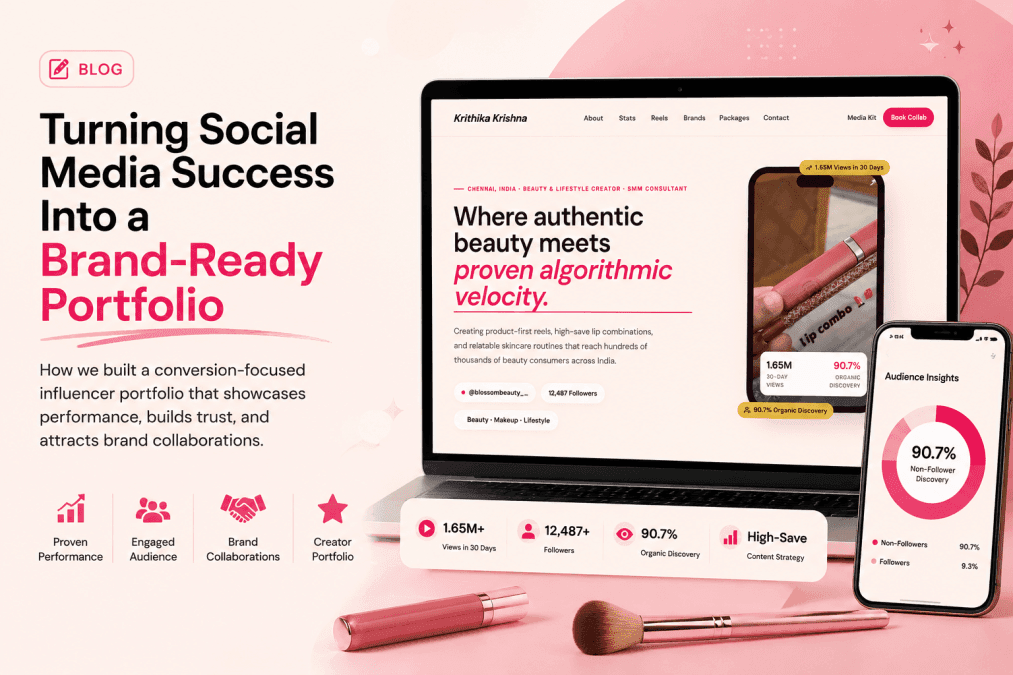
Turning Social Media Success Into a Brand-Ready Portfolio
Social media metrics can prove influence, but they don't always communicate professional value to potential brands. Here's how I turned a creator's scattered performance data, campaign results, and collaborations into a conversion-focused digital portfolio.
Turning Social Media Success Into a Brand-Ready Portfolio
A creator can have thousands of followers, millions of views, successful brand collaborations, and great-performing content.
But there is still an important question:
How easily can a potential brand understand all of that?
This was the problem I wanted to solve while building a portfolio for beauty and lifestyle content creator Krithika Krishna.
The project was not simply about creating another visually attractive website.
The real challenge was turning scattered social media achievements into a professional platform that could communicate value, build trust, and make it easier for potential brands to start a conversation.
The Problem With Relying Only on Social Media
Instagram and other social platforms are great for discovering creators.
But they aren't always the best place to present a complete professional story.
A potential brand might need to understand:
- How large is the creator's reach?
- How does their content perform?
- Who is their audience?
- What previous brands have they worked with?
- What type of content do they create?
- What services or collaborations are available?
- How can we contact them?
Finding all of this information through hundreds of posts, reels, highlights, and screenshots takes time.
And when someone has to work too hard to understand your value, there is always a chance they simply move on.
That is where a dedicated portfolio becomes useful.
The Goal: Build More Than a Digital Resume
I wanted the website to work as more than a portfolio.
It needed to become a central place where a potential brand could quickly understand the creator's professional value.
The structure was designed around a simple journey:
Introduction → Audience Proof → Content Performance → Brand Collaborations → Services → Contact
Each section answers a different question a potential collaborator might have.
Instead of overwhelming visitors with information, the goal was to gradually build confidence.
Turning Numbers Into a Story
One of the most important parts of the project was presenting creator analytics.
Raw numbers are useful.
But numbers without context can feel disconnected.
For example, follower count alone doesn't explain how widely content reaches people outside the existing audience.
A successful portfolio needs to show the bigger picture.
So the performance section focused on metrics such as:
- Monthly content views
- Accounts reached
- Non-follower discovery
- Audience growth
- High-performing content
- Campaign performance
The goal was not to create a complicated analytics dashboard.
It was to make the most important proof points easy to understand within a few seconds.
Why Campaign Case Studies Matter
Brand logos can provide social proof.
But case studies provide context.
Instead of simply saying:
“Worked with this brand.”
A campaign case study can show:
- What type of content was created
- How the campaign performed
- How many people it reached
- How audiences interacted with it
- What made the content successful
This changes the conversation.
The portfolio stops being a list of past work and becomes evidence of what the creator can potentially deliver in the future.
Designing for Both Personality and Business
A creator portfolio has a unique challenge.
It cannot feel too corporate.
But it also cannot feel like just another social media profile.
The design needed to balance both sides.
The creator's personality and visual identity needed to remain visible while the information was structured professionally enough for potential brands and businesses.
That influenced everything from the layout and typography to how campaign results and services were presented.
Thinking About Conversion From the Beginning
When building a client-facing website, I try to think beyond:
“Does this look good?”
A better question is:
“What should the visitor understand or do after seeing this section?”
For this portfolio, the experience was designed to move visitors through a natural progression.
First, they understand who the creator is.
Then they see the audience and performance data.
After that, they explore successful campaigns and previous collaborations.
Finally, they see the available services and have a clear way to start a conversation.
The website was designed to reduce the amount of effort required to answer the question:
“Why should we work with this person?”
The Technical Side
The portfolio was built using:
- Next.js
- React
- Tailwind CSS
- Responsive design principles
- SEO and social metadata
- Vercel for deployment
Performance and responsiveness were important because potential clients could discover the portfolio from any device.
A brand manager opening the website from a phone should have the same clear experience as someone viewing it from a desktop.
What This Project Reinforced
The biggest lesson from this project was simple.
A portfolio should not only show what someone has done. It should help the right person understand why that work matters.
The same principle applies beyond creators.
Whether you are a developer, designer, consultant, photographer, agency, or business owner, your website should not simply be a collection of work.
It should help potential clients connect the dots between:
What you do → What you have achieved → Why it matters → How they can work with you
That was the idea behind this project.
The final result is a portfolio that brings together creator analytics, campaign performance, brand collaborations, services, and contact opportunities into one professional digital experience.
View the Live Project
You can explore the completed influencer portfolio here:
https://krithika-krishna.vercel.app/
If you're a creator, freelancer, or business owner looking to turn your work into a portfolio that does more than just look good, feel free to get in touch.
Was this post helpful?
Comments
0Be the first to share your thoughts.